
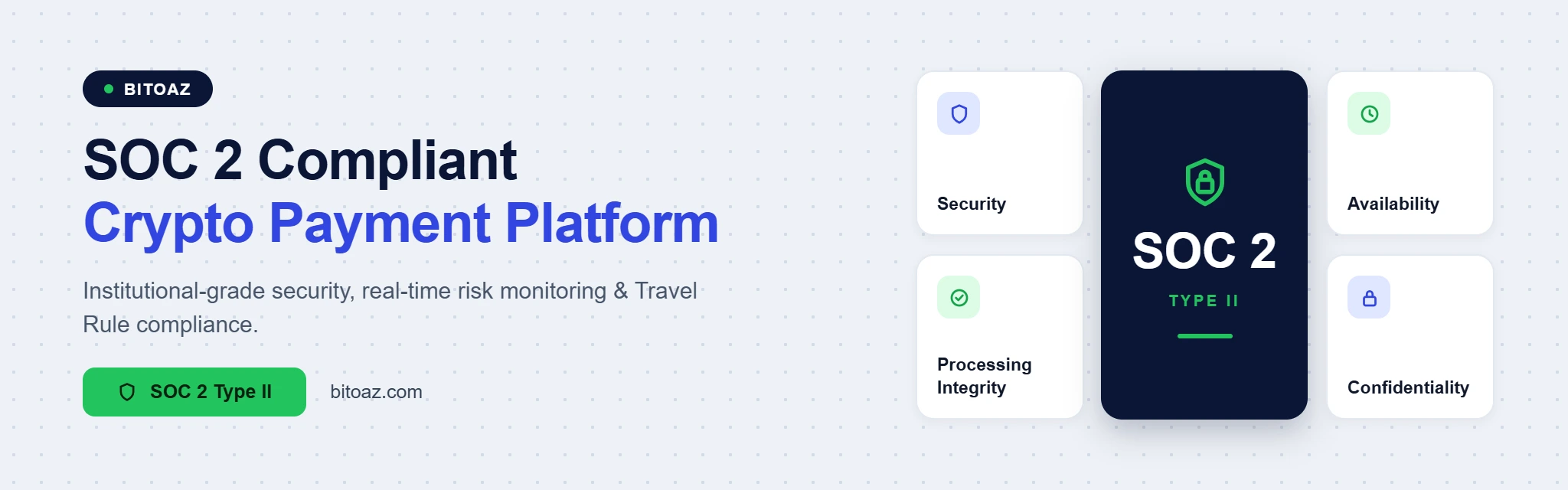
SOC 2 compliance is an independent audit result showing that a company’s security controls are well designed and work as intended. For crypto payments, it matters even more. Buyers expect proof of strong risk management before they process a single transaction. Bitoaz offers both, and it settles merchants in U.S. dollars.
However, adoption brings scrutiny. Financial institutions and corporate buyers want institutional-grade security and real-time risk checks. Therefore, choosing a risk-managed, SOC 2 compliant payment platform is essential for any business that accepts or settles crypto transactions.
Key Takeaways
- SOC 2 is an attestation report from a licensed CPA firm. It is not a certificate.
- Type 2 tests controls over a period, usually 6 to 12 months. Type 1 checks design on one date.
- Security is the only required criterion. Availability, Processing Integrity, Confidentiality and Privacy are optional.
- An unqualified opinion is the goal. Always read the exceptions.
- For crypto payments, SOC 2 works best alongside transaction monitoring, key custody and dollar settlement.
What SOC 2 Compliance Actually Means
SOC stands for System and Organization Controls. The American Institute of Certified Public Accountants (AICPA) created and governs these reports. A SOC 2 examination looks at how a service organization protects the customer data it handles. Only a licensed CPA firm can perform and sign it.
In addition, “SOC 2 compliant” is shorthand. No official “SOC 2 certified” stamp exists. Instead, an auditor issues an opinion on your controls. Buyers read that opinion to decide whether to trust you.
SOC 2 Type 1 vs. Type 2
Both types use the same criteria. The difference is time. A Type 1 report is a snapshot. A Type 2 report is a record of how controls performed over months.
| Factor | Type 1 | Type 2 |
|---|---|---|
| Question answered | Are controls designed correctly? | Did controls work over time? |
| Timeframe | One date | Usually 6 to 12 months |
| Buyer trust | Moderate | Strong, the market standard |
| Best use | A first step toward Type 2 | Enterprise and financial procurement |
For a crypto payment platform, Type 2 is the report that counts. It proves that security controls operated effectively over an extended monitoring period.
The New Baseline: Security Meets On-Chain Speed
Fast settlement and low fees are no longer enough. Merchants and fintech platforms face a distinct risk profile:
- Volatility and liquidity risk: Sharp price moves can change settlement value if assets are not converted right away or pegged to stablecoins.
- On-chain security threats: Smart contract flaws, wallet compromises and key management failures can be existential.
- Regulatory and financial crime exposure: Anti-Money Laundering (AML), Counter-Terrorist Financing (CTF) and Travel Rule requirements call for real-time screening.
To bridge traditional finance (TradFi) and Web3, gateways need strong risk controls and rigorous third-party auditing. As a result, SOC 2 has become a procurement requirement rather than a bonus.
Why SOC 2 Compliance Matters for Crypto Payment Gateways
SOC 2 gives enterprise buyers independent evidence in place of marketing claims. It can answer a security questionnaire before it is sent. In addition, it shortens security reviews, which often stall deals. Moreover, preparing for it builds good habits, such as access reviews, tested backups and documented incident handling.
The Five Trust Services Criteria in Crypto Payments
A SOC 2 report is measured against the AICPA’s Trust Services Criteria. Security is required. You add the others based on the promises you make to customers.
| Criterion | Application in Crypto Payments | Business Impact |
|---|---|---|
| Security (required) | Protection against unauthorized access, private key exposure and infrastructure breaches. | Prevents asset theft and unauthorized API calls. |
| Availability | High-uptime infrastructure for continuous transaction routing. | Reduces drop-offs and checkout downtime. |
| Processing Integrity | Accurate processing, precise ledger logging and error-free fiat conversion. | Prevents double-spending, slippage and balance errors. |
| Confidentiality | Encryption and secure disposal of contracts, merchant data and banking details. | Protects confidential business information. |
| Privacy | Handling of merchant PII and buyer KYC data in line with the privacy notice. | Supports compliance with standards such as GDPR. |
Key takeaway: A SOC 2 Type 2 report shows enterprise buyers and risk officers that your crypto payment stack follows security standards comparable to traditional financial platforms.
What Is Inside a SOC 2 Report
Knowing the structure helps you read a vendor’s report or prepare your own. A typical report has five parts:
- Independent auditor’s report: the CPA firm’s formal opinion.
- Management’s assertion: leadership’s written statement that the system description is accurate.
- System description: the service, infrastructure, people, data flows and scope.
- Controls, tests and results: each control, how it was tested and any exceptions.
- Other information (optional): management responses, not covered by the opinion.
The Four Possible Auditor Opinions
- Unqualified: a clean opinion. This is the goal.
- Qualified: mostly clean, but one or more controls had issues.
- Adverse: controls did not operate effectively.
- Disclaimer: the auditor could not gather enough evidence to form an opinion.
Core Features of an Enterprise-Grade Crypto Risk Management Engine
A robust platform does more than process payments. It actively protects merchants from operational and compliance risk. SOC 2 then verifies that these controls run consistently.
1. Automated On-Chain and Off-Chain Transaction Monitoring
Real-time blockchain analytics screen incoming and outgoing transactions against known illicit wallets, sanctioned entities and darkweb protocols. Immediate risk scoring helps block illicit funds before they reach your balance sheet.
2. Multi-Layer Key Management and Institutional Custody
Securing private keys is the cornerstone of any crypto risk management payment platform. Multi-Party Computation (MPC), Hardware Security Modules (HSMs) and multi-signature governance remove any single point of failure.
3. Automated FX and Volatility Protection
A crypto to fiat payment gateway converts each payment at checkout. Bitoaz settles merchants in U.S. dollars, so they never hold crypto. Furthermore, a single integration can support multiple payment options. Explore One Integration, Multiple Payment Methods to see how businesses can combine crypto, stablecoins and traditional payment rails in one API workflow.
4. Built-In Travel Rule and Global Regulatory Compliance
Automated counterparty checks and Travel Rule compliance support smooth cross-border transfers. As a result, teams avoid regulatory friction and manual compliance work. For background on financial crime standards, see the Financial Action Task Force (FATF).
How Bitoaz Approaches SOC 2 Compliance and Risk Management
Bitoaz brings security, risk management and compliance into one platform:
- SOC 2: independent controls reporting, with reports available to partners under NDA.
- Risk management: merchant onboarding, transaction monitoring and risk controls are managed across the platform.
- U.S. dollar settlement: merchants receive dollars, so they never hold crypto or carry its price risk.
- One integration: Bitcoin, Lightning, USDC, digital wallets and Klarna through one connection.
To see how checkout complexity shapes these choices, read about the checkout puzzle facing scaling digital businesses.
How to Read a Vendor’s SOC 2 Report
Receiving a report is only useful if you read it. Check these five items before you rely on a payment provider:
- The opinion: confirm it is unqualified. Read every exception if it is not.
- The period dates: if the window ended months ago, ask for a bridge letter covering the gap.
- The scope: confirm which systems and criteria were tested. A Security-only report says nothing about Availability.
- The exceptions: exceptions are normal. Unremediated ones are not.
- Complementary user entity controls (CUECs): these are the controls you must run on your side.
Key Questions When Choosing a Stablecoin Payment Gateway
Ask these questions during procurement:
- Does the platform hold an active SOC 2 Type 2 report? Request it under NDA and review the auditor’s findings.
- How does it handle AML/KYC and sanction screening? Automated monitoring should sit inside the API flow.
- What custody architecture protects merchant funds? Look for MPC, segregated accounts and insured vaulting.
- What are the settlement options and SLA guarantees? Verify fiat payout rails, supported blockchains and uptime metrics.
Strategic Partnerships and Growth Opportunities
Scalable crypto payment platforms also create growth models for platforms, agencies and financial affiliates. Join the Payment Distribution Partner Program to offer next-generation crypto checkout, seamless settlement and scalable Web3 infrastructure to your clients.
Frequently Asked Questions About SOC 2 Compliance
Is SOC 2 compliance a certification?
No. SOC 2 is an attestation report issued by a licensed CPA firm. The auditor gives an opinion on your controls. There is no pass or fail badge.
How long does a SOC 2 Type 2 report cover?
It covers an observation period, generally 6, 9 or 12 months. Twelve months is the most common request from enterprise buyers.
What is the difference between SOC 2 Type 1 and Type 2?
Type 1 tests control design on one date. Type 2 tests whether the controls operated effectively across a period of months.
Who needs SOC 2 compliance?
Any provider that stores, processes or transmits customer data needs it. That includes payment platforms, SaaS vendors and data hosts. Enterprise buyers increasingly require it before signing a contract.
Is SOC 2 enough to prove a crypto payment platform is safe?
Not on its own. SOC 2 verifies that controls work. You should also confirm transaction monitoring, key custody, AML screening and settlement terms.
Conclusion
SOC 2 compliance gives enterprise buyers independent proof that a payment platform’s controls work over time. For crypto, it should sit alongside real-time transaction monitoring, strong key custody and U.S. dollar settlement. A Type 2 report with a clean opinion, a clear scope and remediated exceptions is the strongest signal. Choose a SOC 2 compliant, risk-managed platform to protect your business, meet regulatory expectations and build lasting trust with institutional clients.

1 comment