
Alternative Payment Methods: Solving the Checkout Puzzle with One Integration
Alternative payment methods are ways to pay other than cash and traditional cards. They include digital wallets such as PayPal, Venmo, Cash App, Alipay and WeChat Pay, buy now, pay later (BNPL) services such as Klarna, and digital assets such as Bitcoin and USDC. Customers now expect them at checkout. However, adding each one separately creates friction, overhead and security gaps.
Enterprises can no longer afford stitched-together gateways. To stay competitive, platforms need one integration for multiple payment methods and rigorous SOC 2 compliance. This guide defines each type, explains the benefits and risks, and shows how to choose and add them without rebuilding your stack.
What Are Alternative Payment Methods?
An alternative payment method (APM) is any way for a customer to pay that does not run on a standard credit or debit card network. Some APMs still draw on a bank account or card behind the scenes. Even so, the customer pays through a different interface, account or rail.
For merchants, the term matters because each method has its own checkout flow, fee structure, settlement timing and dispute process. Therefore, each one adds operational work unless a platform unifies them.
Types of Alternative Payment Methods
Digital Wallets
Wallets store payment credentials so buyers can pay in a few taps. Examples include PayPal, Venmo, Cash App, Alipay and WeChat Pay. In addition, they are especially strong in regions where a local wallet is the default way to pay.
Buy Now, Pay Later (BNPL)
BNPL lets customers split a purchase into installments. Klarna is a well-known example. As a result, BNPL can support larger basket sizes, although merchants should review fees and return handling.
Digital Assets and Stablecoins
Bitcoin, Bitcoin Lightning and USDC let customers pay on blockchain rails. Stablecoins such as USDC are pegged to a currency, which limits price swings. Settlement is fast and works across borders without correspondent banks.
Bank Transfers and Local Methods
Regional bank debits and transfers are common in many markets. For example, buyers in some countries prefer them over cards. Supporting them can lift conversion in those regions.
Why Businesses Accept Alternative Payment Methods
- Better checkout conversion: Buyers who see their preferred option are less likely to abandon the cart.
- Wider market reach: Local wallets and bank methods open regions where card use is low.
- Lower cross-border friction: Some methods reduce currency conversion steps and fees.
- Stronger security: Tokenization and biometric sign-in keep card numbers away from merchant systems.
- Financial inclusion: Wallets and digital assets serve buyers without traditional bank access.
Challenges of Adding Alternative Payment Methods
Integration and Reconciliation
Every separate vendor brings its own API, reports and payout schedule. Consequently, finance teams struggle to match orders to deposits. Handling multiple rails traditionally meant separate vendors for fiat processing, regional transfers and digital asset custody. This fractures data reporting and raises abandonment.
Regulation and Compliance
Rules differ by country and by payment type, especially for digital assets. Merchants should confirm requirements with qualified legal and compliance advisers. The Financial Action Task Force publishes global standards on virtual assets that many regulators follow.
Price Volatility and Fraud Risk
Crypto prices can move quickly, and some methods have different chargeback rules. However, settling in U.S. dollars removes price risk for the merchant. Strong monitoring then handles fraud.
Customer Education
Some buyers are unfamiliar with newer options. Clear checkout labels and short help text build confidence.
The Power of One Integration for Alternative Payment Processing
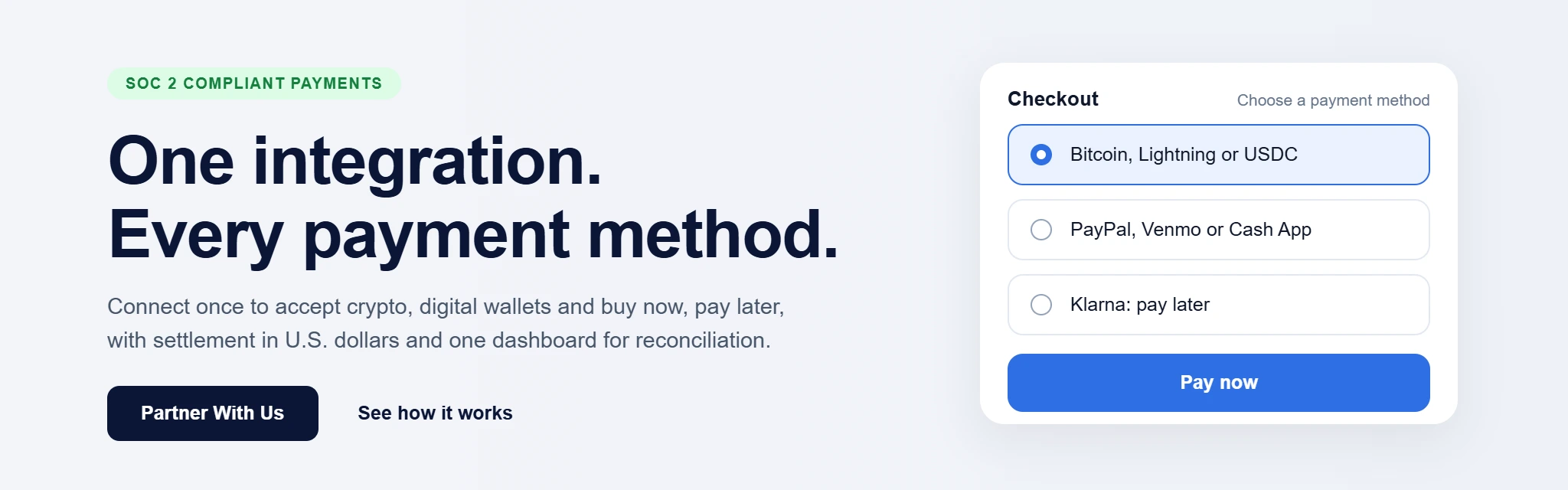
A unified checkout architecture lets merchants deploy a single API that opens an entire ecosystem of payment options. Whether a customer pays with a card rail or a fast-settling stablecoin, the transaction flows through one pipeline.
Core Benefits for Growing Enterprises
- Reduced Development Overhead: Implement a single, robust API and SDK set instead of maintaining multiple disparate payment modules.
- Optimized Checkout Experience: Present localized, preferred payment methods dynamically based on the buyer’s geographical region.
- Instant Reconciliation: Centralize transaction monitoring, refunds, and analytics into a single dashboard.
How to Choose Alternative Payment Methods for Your Business
- Study your customers: Review checkout data by region, device and cart size to see which methods buyers use.
- Compare total cost: Look at fees, settlement time, refund handling and chargeback rules for each method.
- Check compatibility: Confirm the provider works with your current ecommerce platform, ERP and accounting tools.
- Verify security: Ask for an independent SOC 2 report and review tokenization and access controls.
- Launch in phases: Start with the highest-demand methods, then measure conversion and expand.
Why SOC 2 Compliance Is Non-Negotiable
When processing financial transactions at scale, security is the baseline. Institutional buyers treat SOC 2 compliance as a requirement, not an optional feature. SOC 2 is an auditing framework from the AICPA that tests a provider’s controls.
A rigorous SOC 2 framework covers security, availability and processing integrity. It confirms that a payment provider follows strict operational controls:
- Data Protection & Tokenization: Sensitive customer information and payment credentials are securely processed and isolated.
- System Uptime & Reliability: High availability standards support steady performance during high-volume sales events.
- Streamlined Vendor Onboarding: Enterprise security teams can fast-track reviews when a platform maintains active, independently audited compliance reports.
For a deeper look at governance, see our guide to a risk management payment platform for Web3 commerce.
Future Trends in Alternative Payment Methods
- Stablecoin adoption: Dollar-pegged tokens are moving into everyday commerce and cross-border settlement.
- Faster cross-border payments: Newer rails cut delays and currency barriers.
- AI-driven fraud detection: Machine learning spots unusual activity earlier.
- Wider financial inclusion: Mobile-first methods reach underserved buyers.
Introducing Bitoaz: One Integration for Alternative Payment Methods
Bitoaz bridges conventional digital finance and next-generation blockchain rails. Designed for modern merchants, the platform combines multi-rail flexibility with institutional-grade security.
What Sets Bitoaz Apart
- One Integration, Many Payment Methods: Connect once through Bitoaz APIs and webhooks to accept Bitcoin, Bitcoin Lightning, USDC, PayPal, Venmo, Cash App, Alipay, WeChat Pay and Klarna.
- Enterprise-Grade Security: Fully SOC 2 compliant payment platform, with strict access controls and reliability for high-volume operations.
- U.S. Dollar Settlement: Merchants are settled in U.S. dollars, so they never hold crypto or carry its price risk.
Frequently Asked Questions About Alternative Payment Methods
What are examples of alternative payment methods?
Common examples are PayPal, Venmo, Cash App, Alipay, WeChat Pay, Klarna, Bitcoin and USDC. Regional bank transfers also count.
Do alternative payment methods cost less than cards?
It depends on the method and region. Some lower cross-border costs, while others, such as BNPL, may cost more. Compare total fees before you launch.
Can a merchant accept crypto without holding it?
Yes. With U.S. dollar settlement, the platform converts payments so the merchant never holds crypto or carries price risk.
Are alternative payment methods secure?
Many use tokenization and biometric sign-in. Still, security depends on the provider, so look for independent audits such as SOC 2.
Conclusion
Alternative payment methods now sit at the center of digital commerce. They lift conversion, widen reach and improve security, but only if integration, compliance and reconciliation stay manageable. By consolidating checkout into a single, SOC 2 compliant gateway, you reduce complexity while building trust with customers.
Ready to future-proof your checkout experience? Talk to Bitoaz about a partnership to see how effortless multi-rail, SOC 2 compliant payment integration can be.
This article is educational and is not legal, tax or financial advice.

1 comment